Wondering if you can make an Arvada home help pay for itself? If you are thinking about buying a home with extra income potential, Arvada gives you more real options than many buyers expect. With the right property, layout, and permits, you may be able to offset housing costs through a basement suite, attached unit, or detached backyard ADU. Let’s dive in.
Why Arvada works for house hacking
Arvada stands out because the city allows accessory dwelling units in residential zone districts when there is an existing detached single-family home on the lot. In practical terms, that opens the door to several common house-hacking setups, including a basement conversion, an attached suite, or a detached backyard cottage.
The city recognizes two main ADU types. Type A is a detached unit, and Type B is a unit inside or attached to the main single-family home where the occupants do not live together as one household. Both are treated as separate dwelling units under the building code, which matters if you want a setup that functions like an independent living space.
Know the Arvada ADU rules
Before you start sketching ideas, it helps to understand the rules that shape what is actually possible. Arvada is ADU-friendly, but it is not a free-for-all.
Owner occupancy is required
Arvada requires owner occupancy for properties with an ADU. That means you must live in either the main home or the ADU, and the certificate of occupancy stays tied to that owner-occupied arrangement.
You also can only have one ADU per parcel. The ADU cannot be sold separately from the main home, so this is a long-term shared-property setup rather than a split ownership strategy.
Size and lot limits matter
For newly built Type A units and Type B additions, the ADU cannot exceed 40% of the primary home’s living space. The allowed size also depends on lot size.
There is an important exception for Type B units built within the existing footprint of the home, such as many basement conversions. Those are exempt from the general size caps, but they are limited to 50% of the principal dwelling’s floor area. Garages, unfinished basements, and patios do not count as living space.
Build requirements are real
Arvada requires fire separation and a separate HVAC system for ADUs. For internal Type B units, sound control also matters because the city requires approved separation details and an STC rating of 45 or greater.
The ADU must connect to the primary dwelling’s water and sanitary sewer service instead of having separate utility services. If the property is in an HOA, city approval does not override HOA approval, so both need to be checked early.
Setbacks can affect detached units
If you are hoping to build a detached Type A ADU, lot layout becomes a big part of the conversation. On corner lots, Arvada requires Type A ADUs to sit at least 10 feet behind the main home’s façade along both street frontages.
That rule does not mean a detached unit is off the table. It just means the lot has to support the placement, setbacks, and access before the idea works on paper and in permitting.
Best house hacking layouts in Arvada
Not every extra room is a house hack. The most useful setups are the ones that function like a true independent living space.
Basement suites
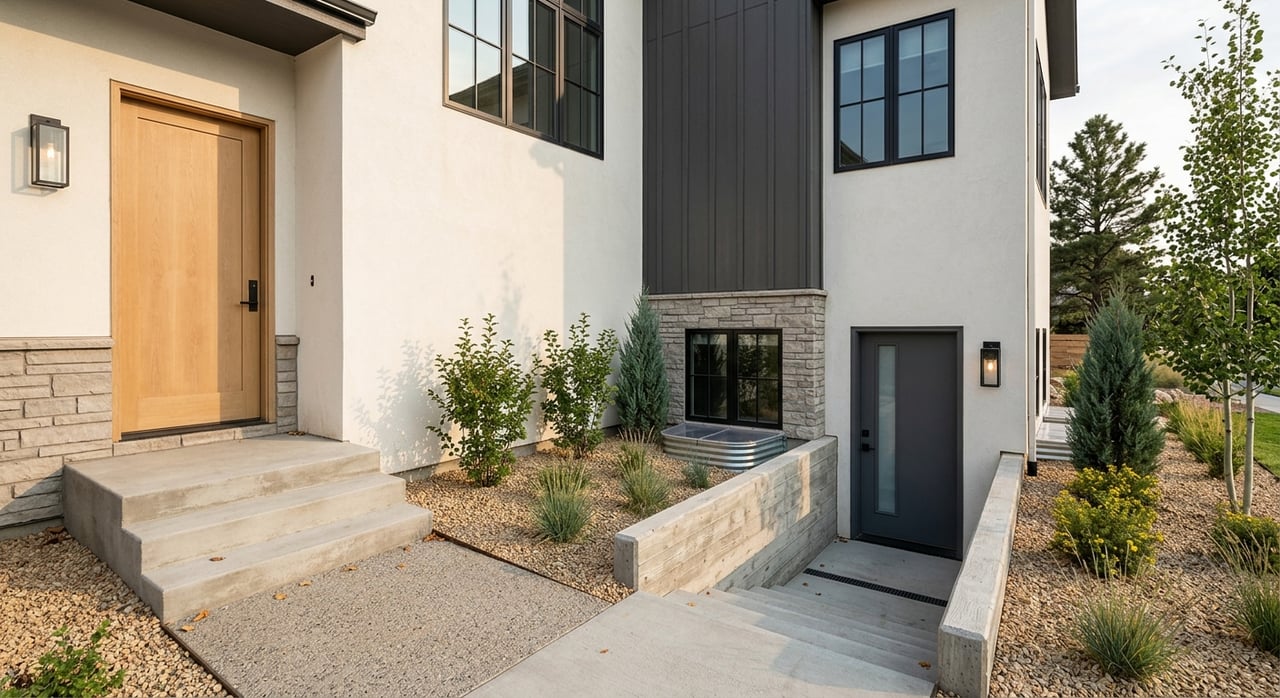
A basement suite is often the first option buyers look at in Arvada, especially in older detached homes. This can be a strong fit when the lower level can support a separate entrance, kitchen, bathroom, sleeping area, and enough privacy that the occupant does not need to move through your living space.
This is where Arvada’s Type B rules are especially important. If the basement is within the home’s existing footprint, you may have more flexibility on size, but you still need legal separation, sound control, and code-compliant design.
Attached or internal suites
Some homes offer a side wing, finished lower level, or lock-off area that works better than a full basement conversion. These attached or internal suites can be appealing if you want rental income while keeping construction more contained than a detached build.
From a design and usability standpoint, privacy is everything. Separate access, clear circulation, and practical utility routing often make the difference between a space that merely exists and one that can actually function well.
Detached backyard ADUs
If the lot is large enough, a detached ADU can offer the most separation between owner and tenant. That can be attractive if you want a cleaner division of space and a more standalone feel.
In Arvada, detached units are usually best suited to properties where lot size and setbacks work in your favor. Buyers considering this route should pay close attention to zoning standards, utility routing, and buildable placement on the lot.
Property types to watch in Arvada
House hacking in Arvada is often less about one specific neighborhood and more about matching the strategy to the property type. The city’s housing patterns can help you narrow your search.
Older detached homes
Arvada’s housing plan notes that the city has an older housing stock. Planning materials also indicate that older, lower-value homes are more common in the eastern reaches of the city, while newer, higher-value homes are more common in the west and near Olde Town.
For buyers, that suggests older east and central Arvada homes may be worth a closer look for basement or internal-suite potential. Since many of these properties may need repairs or accessibility improvements, it is smart to budget for renovation and retrofit costs in addition to the purchase price.
Larger-lot western homes
In western parts of Arvada, larger lots may be better candidates for detached backyard ADUs if zoning and setbacks line up. These properties can be appealing if your goal is more privacy between the main home and the rental unit.
That said, larger lot does not automatically mean easy approval. You still need to confirm what the specific parcel can support.
Olde Town zoning opportunities
Olde Town presents a different kind of opportunity. The Olde Town Residential Neighborhood and Olde Town Grandview districts are mixed-use zoning areas that allow combinations such as single-family dwellings, duplexes, multiplexes, and accessory building form types.
If you are open to built-in rental flexibility rather than converting a standard detached house, these districts are worth a closer look. For some buyers, that may be a more straightforward fit than creating a new ADU from scratch.
Financing questions to ask early
House hacking can look great on a spreadsheet, but financing details need to be nailed down early. The key issue is that projected rent is not automatic qualifying income.
Fannie Mae says ADUs can be financed with its Selling Guide products, and rental income from an existing ADU on a one-unit principal residence may be used to help qualify under specific conditions. Freddie Mac also states that ADU properties can be financed through its mortgage offerings, and ADU rental income may count if program requirements are met.
For buyers in Arvada, the practical takeaway is simple. If you plan to rely on ADU income, confirm the loan product, the permit status, and how the lender will treat that income before you make your purchase decision.
A smart Arvada house hack checklist
When you evaluate a property, focus on what is buildable and approvable, not just what looks possible during a showing.
- Confirm there is an existing detached single-family home on the lot if you are pursuing an ADU
- Verify zoning district standards through the city’s maps and property search tools
- Check whether the layout can support a separate entrance, kitchen, bathroom, and sleeping area
- Review fire separation, sound control, and separate HVAC requirements
- Ask how water and sewer connections will work through the primary dwelling’s service
- Confirm setback constraints for any detached ADU plan
- Review HOA rules if the property is in a covenant-controlled community
- Budget for renovation, retrofit, and permitting costs
- Talk with your lender about whether legal ADU income may help you qualify
Short-term rental is a separate path
Some buyers ask whether they can use short-term rental income instead of a traditional lease. In Arvada, that is a separate regulated use, not the same thing as a standard long-term ADU strategy.
The city requires both a short-term rental permit and a business license. Arvada also limits a lot to one short-term rental permit and says only the primary residence or a secondary residence such as an ADU may be permitted, not both.
Why local guidance matters
House hacking in Arvada can be a great strategy, but success usually comes down to the details. The best opportunities are the ones where property layout, city rules, renovation scope, and financing all work together from the start.
That is why a design-aware search can make such a difference. When you know how to read a floor plan, spot utility and separation issues, and evaluate renovation readiness before you write an offer, you can avoid buying a property with expensive surprises.
If you are exploring house hacking options in Arvada and want help finding a property that fits both your goals and the city’s rules, Audrey Michel can help you evaluate layout potential, renovation readiness, and next steps with a practical local lens.
FAQs
Can you convert a basement into a rental unit in Arvada?
- Yes, but only if the space becomes a legal Type B ADU or another permitted configuration that meets Arvada’s rules for separation, utilities, and owner occupancy.
Can you build a backyard cottage on an Arvada property?
- Yes, if the lot size, setbacks, zoning standards, permit requirements, and any HOA rules all support a detached Type A ADU.
Can ADU rent help you qualify for a mortgage in Arvada?
- Potentially, yes. Lender treatment of ADU income depends on the loan program, and the ADU generally needs to be legal and documented.
Can you use short-term rental as a house hacking strategy in Arvada?
- Possibly, but Arvada regulates short-term rentals separately and requires a permit and business license, with limits on how many short-term rental permits a lot can have.
What kinds of Arvada homes are often the best fit for house hacking?
- Older detached homes may offer basement or internal-suite potential, while larger-lot properties may be stronger candidates for detached ADUs if zoning and site conditions work.